
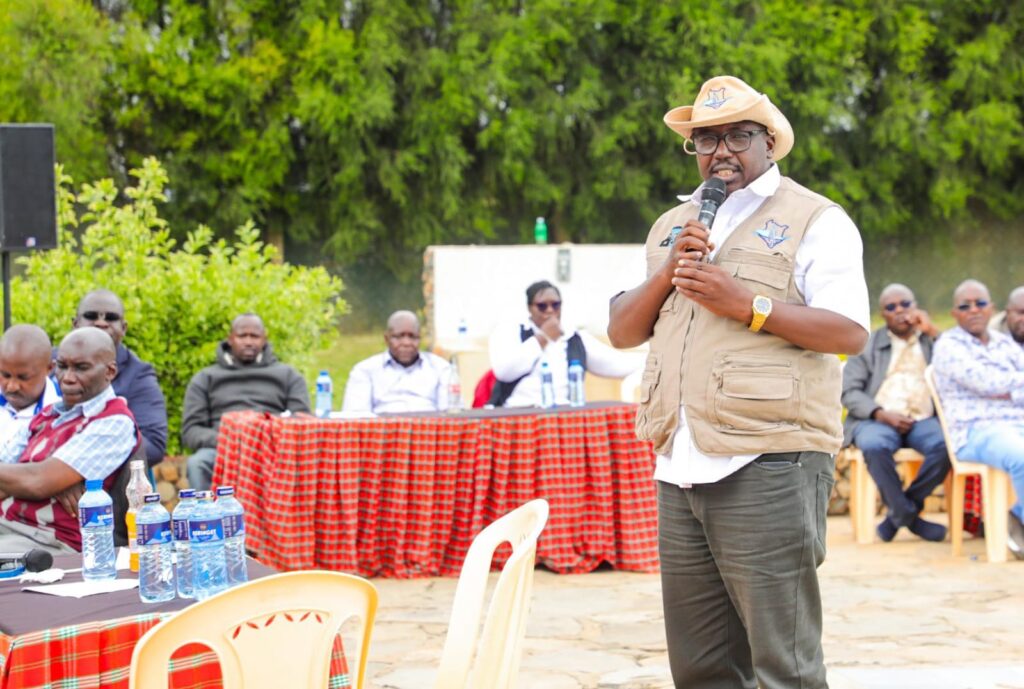
The National Water Harvesting and Storage Authority (NWHSA) has reaffirmed its commitment to strengthening institutional excellence, accelerating water infrastructure development, and fostering a high-performance culture as it embarks on the 2026/2027 Financial Year.
Addressing staff during the staff performance review meeting, Ag. CEO Eng. Julius Mugun commended employees for their dedication and contribution to the Authority’s achievements during the 2025/2026 Financial Year. He acknowledged that the progress realized across the institution was a result of the collective efforts of staff serving at the headquarters, regional offices, and project sites across the country.
Eng. Mugun highlighted significant milestones achieved despite resource constraints, noting that the Authority continued to implement its statutory mandate through strategic investments in water infrastructure. Among the flagship projects were the ongoing construction of the Siyoi-Muruny Water Project and Umaa Dam, alongside the completion of 76 water supply projects comprising weirs, small earth dams, boreholes, and associated water supply systems.
Together, these projects harvested and stored approximately 1.196 million cubic metres of water, benefiting more than 115,000 people with improved access to water while supporting irrigation on over 12,000 acres of land, thereby contributing to enhanced food production and improved livelihoods.
The Authority also rehabilitated several water storage facilities, including small dams, water pans, boreholes, and weirs, restoring their original storage capacity and making over 300,000 cubic metres of water available for domestic, livestock, and agricultural use. These interventions expanded access to water for more than 125,000 people and an estimated 500,000 livestock.
Additionally, flood control initiatives undertaken in Budalang’i, River Kuja, and West Kano protected lives and property, reclaimed approximately 1,000 acres of land for productive use, and enhanced the resilience of communities vulnerable to flooding.
Beyond infrastructure development, the Acting CEO noted that the Authority had strengthened its institutional capacity through improved governance systems, enhanced accountability, digitization of internal processes, stronger stakeholder engagement, and strategic partnerships with county governments and development partners. These reforms have positioned the Authority to better support national priorities, including food security, climate resilience, universal access to water, and employment creation.
Recognizing that people remain the Authority’s greatest asset, Eng. Mugun underscored the importance of investing in human capital. He highlighted the Board and Management’s deliberate efforts to cultivate a culture of teamwork under the guiding principle of “One Authority, One Vision, One Team.” The Authority also promoted fairness and transparency by providing equitable opportunities for staff participation in committees, project assignments, and professional development initiatives.
He further noted that the approval of key Human Resource instruments by the relevant Government agencies had laid a strong foundation for improved staff welfare, career progression, and motivation.
The Authority also invested in strengthening its corporate identity through improved branding, enhanced visibility, and the facelift of its headquarters, reinforcing stakeholder confidence and projecting a stronger institutional image.
Looking ahead to the 2026/2027 Financial Year, Eng. Mugun said the Authority would prioritize the completion of ongoing flagship projects, particularly the Siyoi-Muruny Water Project and Umaa Dam, which are expected to inject an additional 10 million cubic metres of water into the country’s storage capacity. Plans are also underway to commence new strategic dam projects, expand water harvesting programmes, implement climate resilience initiatives, and deploy a digital project management system developed using in-house expertise to improve project monitoring and performance.
The Acting CEO further revealed that the Authority is positioning itself to leverage the National Infrastructure Fund to finance transformative water infrastructure projects through bulk water supply initiatives. This innovative financing approach is expected to unlock investment in strategic dams, bulk water systems, and national water security projects while strengthening the Authority’s long-term financial sustainability.
As the Authority enters the new financial year, Eng. Mugun challenged every member of staff to embrace higher standards of productivity, professionalism, innovation, integrity, teamwork, and accountability. He emphasized that every employee should become a solution provider committed to delivering measurable results.
He also announced plans to progressively implement biometric attendance integrated with payroll as part of broader efforts to strengthen accountability, improve productivity, and promote fairness in attendance management in line with Government regulations and approved Human Resource policies.
Concluding his address, Eng. Mugun called on staff to remain focused on the Authority’s vision of “Sufficient Water Storage for All.” He urged employees to move into the new financial year with renewed commitment, shared purpose, and a determination to improve the lives of Kenyans through secure, sustainable, and accessible water solutions.
“History will judge us not by the meetings we held or the reports we wrote, but by the lives we improved through secure, sustainable and accessible water. Together, we will build a stronger National Water Harvesting and Storage Authority, a more water-secure Kenya, and a more prosperous nation for generations to come.” Eng. Julius Mugun.