
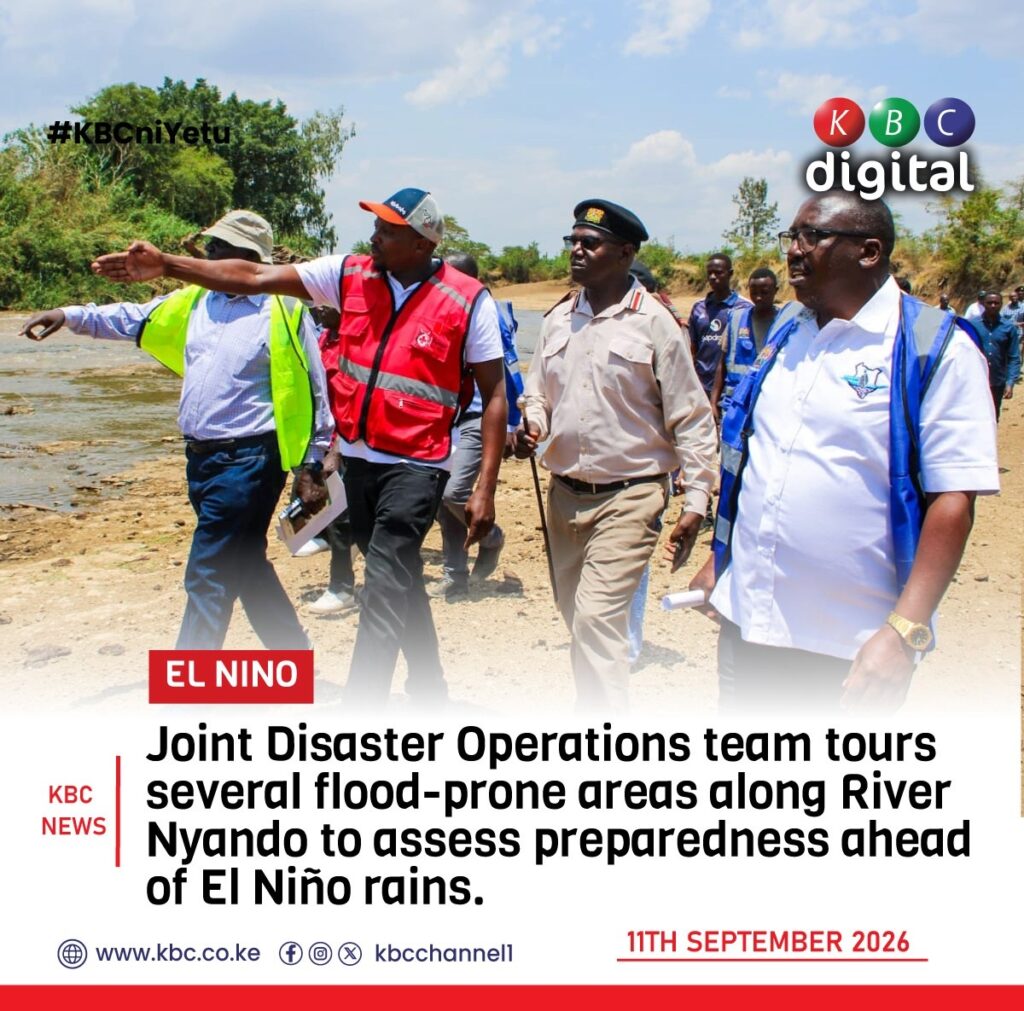
The multi-agency team is undertaking a joint assessment of vulnerable areas and existing flood-control infrastructure to strengthen preparedness, identify potential risks and support timely interventions to protect lives, property and livelihoods.
The National Water Harvesting and Storage Authority (NWHSA), in collaboration with the National Disaster Operations Centre (NDOC), Kenya Red Cross Society, the County Government of Kisumu, National Government Administrative Officers (NGAO) and local communities, has intensified preparedness efforts in flood-prone areas along River Nyando ahead of the anticipated El Niño rains.
As part of the exercise, the team paid a courtesy call to the Governor of Kisumu, Prof. Anyang’ Nyong’o, and the Kisumu County Commissioner, Ramadhan Mwabudzo, where discussions focused on flood preparedness and the areas most vulnerable to flooding, particularly communities living along River Nyando.
Led by NWHSA Acting Chief Executive Officer, Eng. Julius Mugun, the multi-agency team toured several flood-prone locations along River Nyando to assess the level of preparedness on the ground.
The areas visited included the Eastern Dyke at Ahero, the Western Dyke towards Ombaka and West Kano, as well as other critical points along the Nyando River. The team also assessed vulnerable locations including Nyakamaki, Konim, Kona Abiayo, Oketha and the Nyakach/Sondu-Miriu Bridge.
The assessment focused on the condition of existing flood-control infrastructure, river banks and areas vulnerable to overtopping, erosion and flooding. It also provided an opportunity for stakeholders to identify preparedness gaps, areas requiring urgent attention and interventions needed to strengthen flood resilience.
The joint exercise brings together the technical and operational capabilities of national and county government agencies, disaster-response actors and communities. Through this coordinated approach, NWHSA and its partners are able to assess risks on the ground, share information and identify practical measures that can be implemented before heavy rains intensify.
Following the assessment, the team identified a number of short-term measures aimed at reducing flood risks in the identified hotspots. These include desilting water channels and drainage systems, clearing blocked waterways and reinforcing vulnerable sections of river banks using gabions and other appropriate protection measures.
The team also recommended strengthening and repairing sections of the existing dykes and addressing weak points along river banks that could increase the risk of overtopping, erosion and flooding during periods of heavy rainfall.
These interventions are particularly important for communities living in low-lying and flood-prone areas, where flooding can disrupt livelihoods, damage property and infrastructure, and expose communities to significant risks.
Beyond physical infrastructure, the multi-agency team emphasized the importance of community participation in disaster preparedness and response.
NWHSA, NDOC, Kenya Red Cross, the County Government of Kisumu, NGAO and community representatives are working together to strengthen public awareness and ensure that communities receive and act on early-warning information. The team emphasized the need for community sensitization on safe response measures and strengthened coordination between government agencies, disaster-response actors and local communities.
Community engagement is critical because residents living along River Nyando are often the first to experience the impacts of rising water levels and flooding. Their knowledge of local flood patterns and vulnerable areas also provides valuable information to responders and technical teams undertaking preparedness assessments.
The multi-agency approach therefore goes beyond inspecting infrastructure. It seeks to build a coordinated preparedness system in which government agencies, humanitarian organizations, local administrators and communities work together to anticipate risks, share information and take early action.
The Kisumu assessment underscores the importance of proactive disaster preparedness, particularly in areas that are historically vulnerable to flooding. The findings will guide immediate interventions in identified hotspots while also informing longer-term measures to strengthen flood-control systems and enhance the resilience of communities along River Nyando.
For NWHSA, the exercise reinforces its role in supporting national efforts on water harvesting and storage, flood control and climate resilience. Working alongside NDOC, Kenya Red Cross, the County Government of Kisumu, NGAO and communities, the Authority continues to support coordinated action aimed at reducing the impacts of flooding and safeguarding lives, property and livelihoods.
The joint preparedness exercise demonstrates that effective flood management requires more than infrastructure alone. It calls for early action, reliable early-warning systems, strong institutions, community participation and sustained collaboration among all actors.
Written by:
Joyce Jepkemboi
Manager; Corporate Communication
15th September, 2026